Launch offer — valid today only

📄 Digital book in PDF · read it on your phone or print it

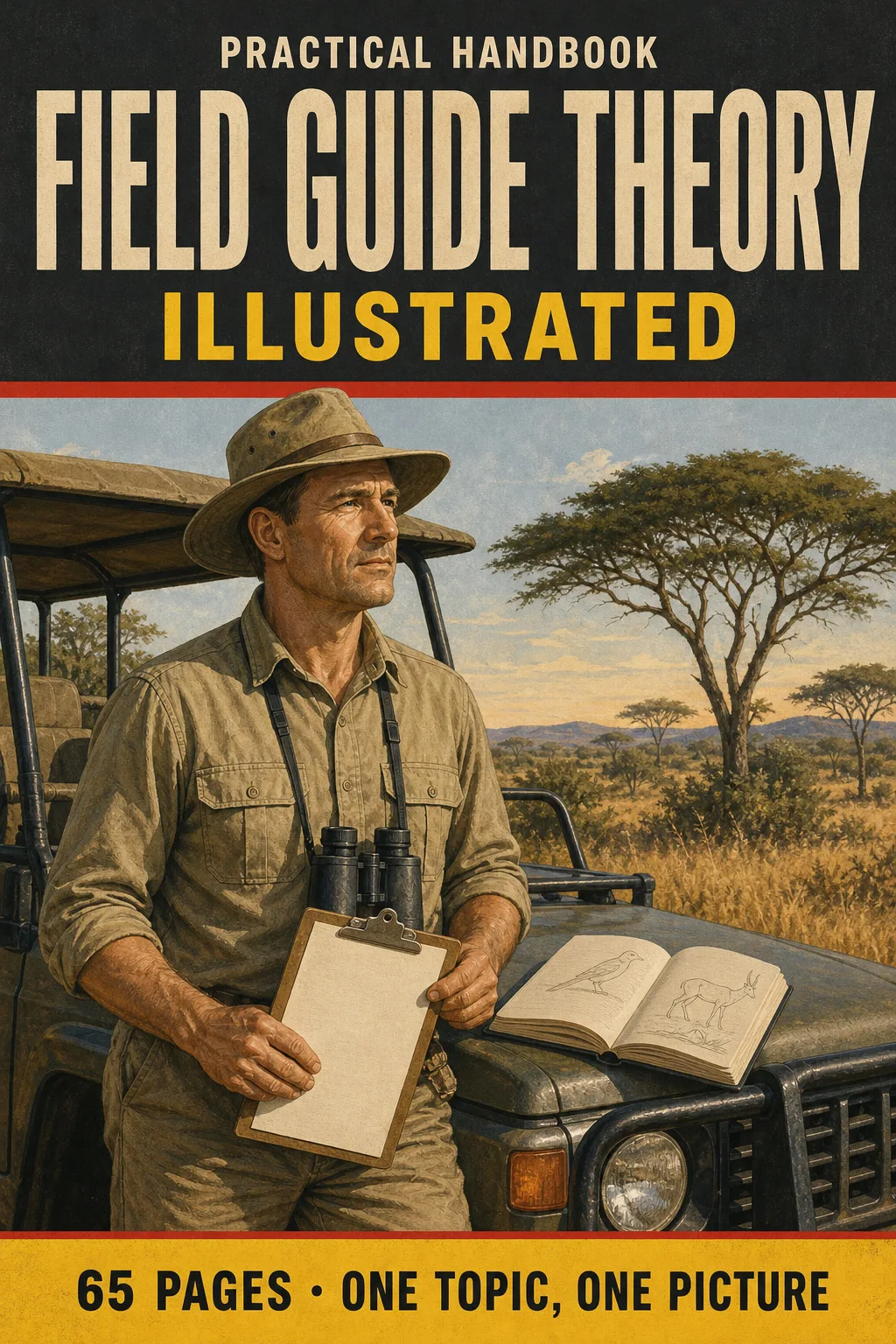
NQF2 Field Guide Theory in Drawings So Look-Alike Antelope, Rocks and Spoor Stop Blurring

For the South African NQF2 nature site guide theory exam. Biomes, rocks and soils, taxonomy, big mammals, antelope, birds, trees and grasses, spoor and safe conduct: each topic on its own page, the drawing first, then what you need to remember. 65 illustrated pages.

YES, I WANT THE 65 DRAWN PAGES

🔒 Secure checkout · PDF by email · 30-day guarantee

Every topic, its own pageEach identification drawn, with the explanation beside it
65 illustrated pages9 parts, from the guide's role to exam practice
Up-to-date sourcesSAQA NQF2 unit standards, the FGASA theory syllabus and SANBI biomes
PDF by emailFormat

Look Inside the Book

Every page has one large drawing and a box with the features and steps you need to know:

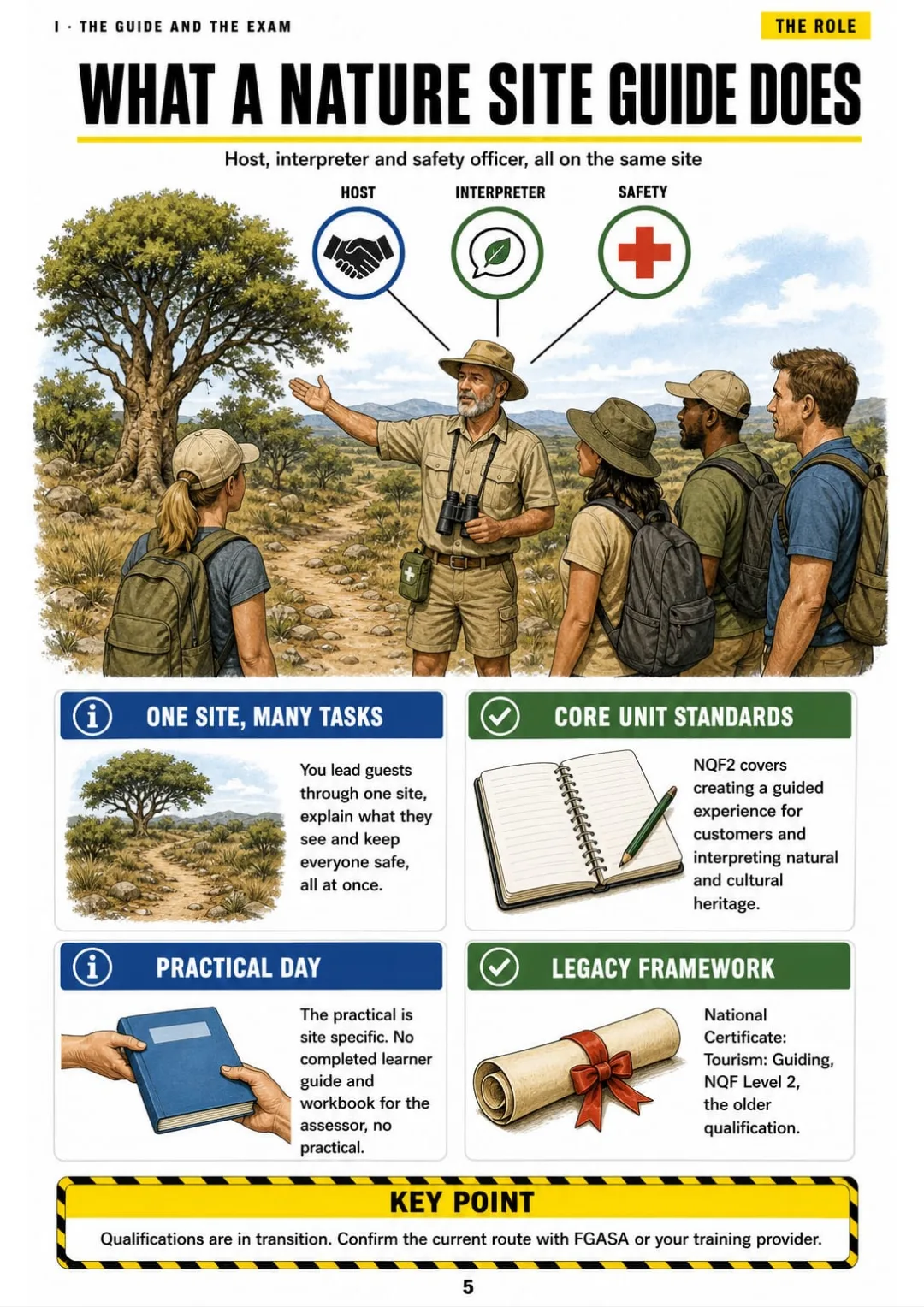
NQF2 guide: host, interpreter and safety officer on one site, drawn as three icons
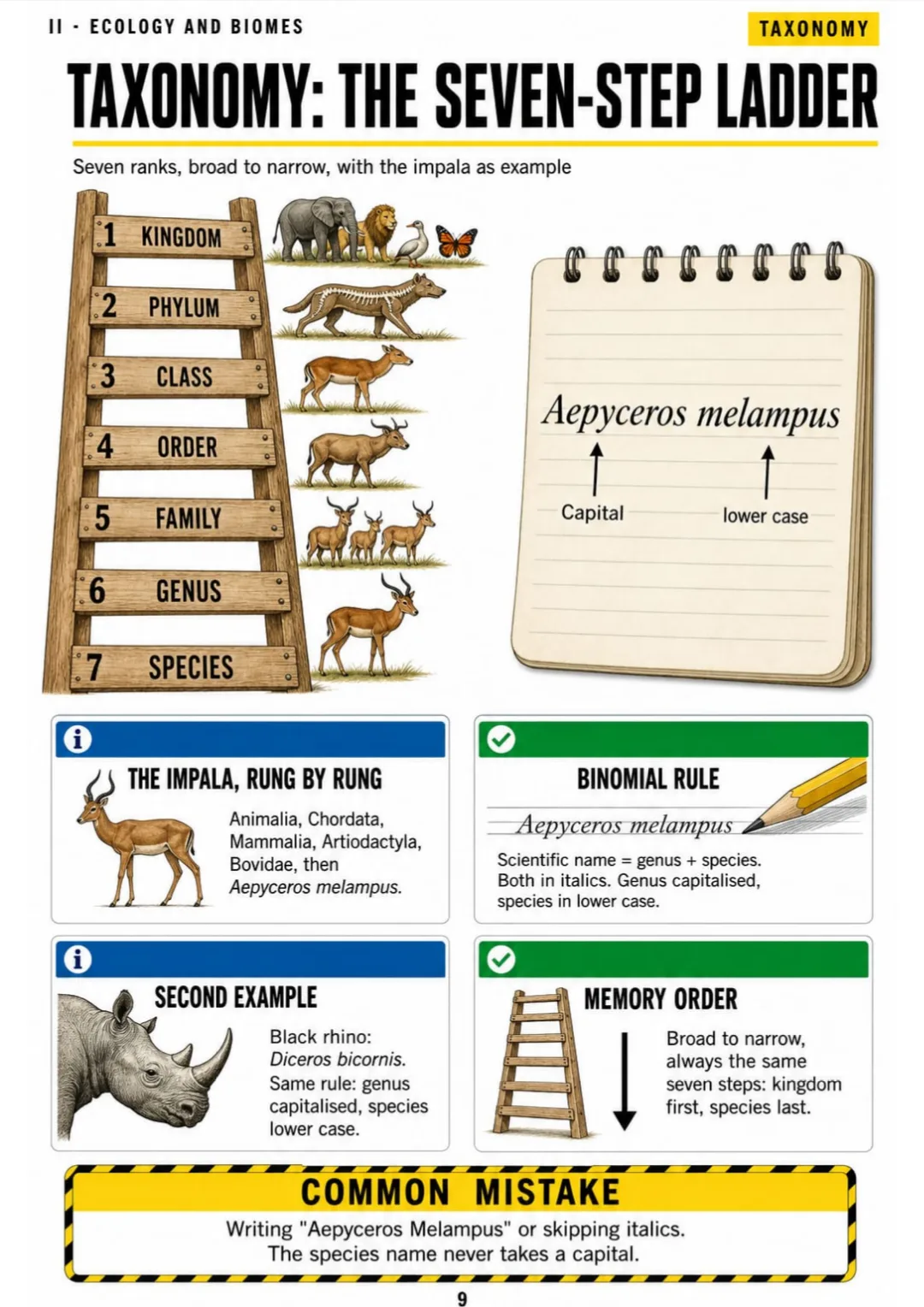
Kingdom to species in seven rungs: Aepyceros melampus, genus capitalised, both in italics.
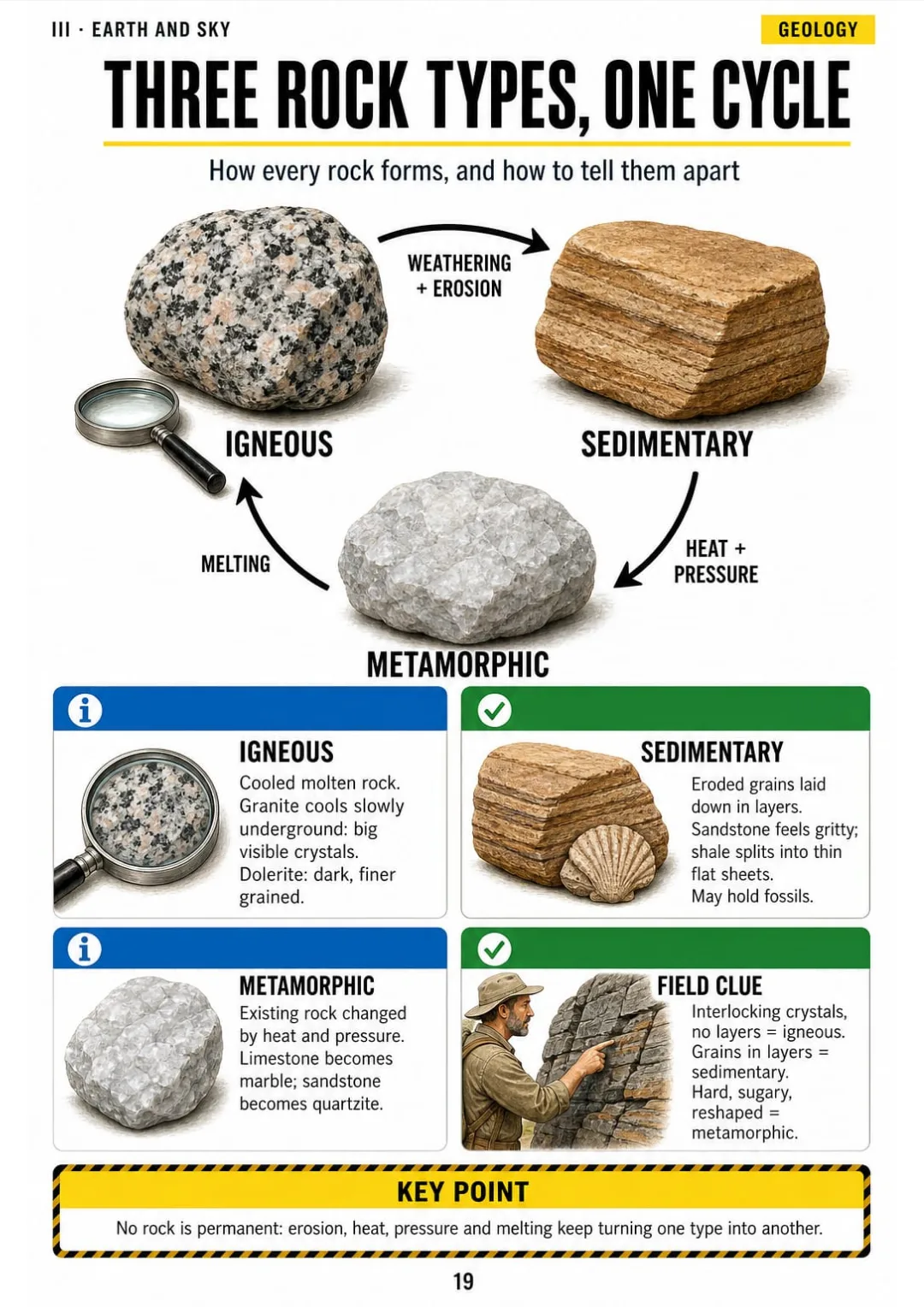
Igneous, sedimentary, metamorphic: crystals, layers or reshaped by heat and pressure.
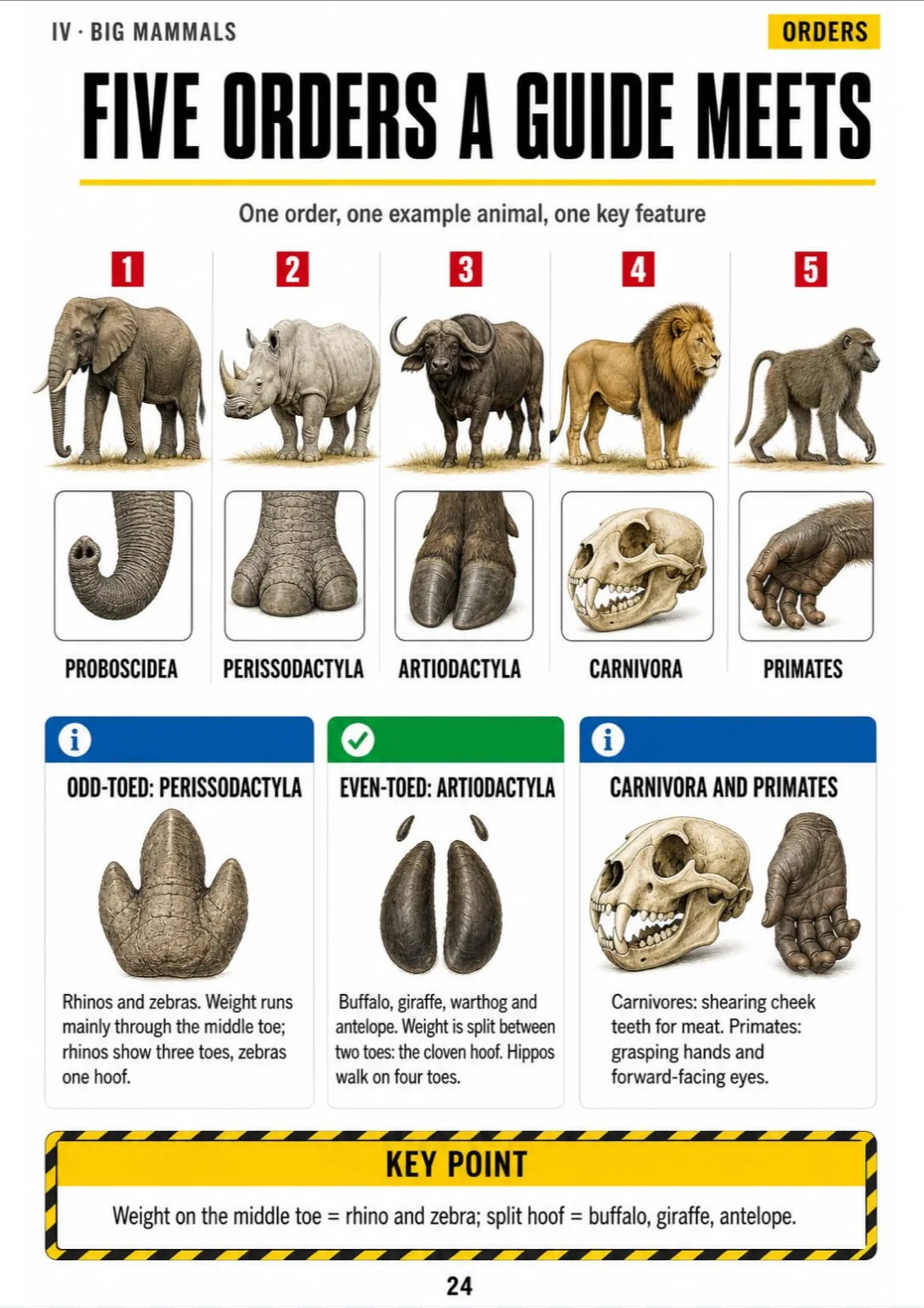
Proboscidea, Perissodactyla, Artiodactyla, Carnivora, Primates: one example each
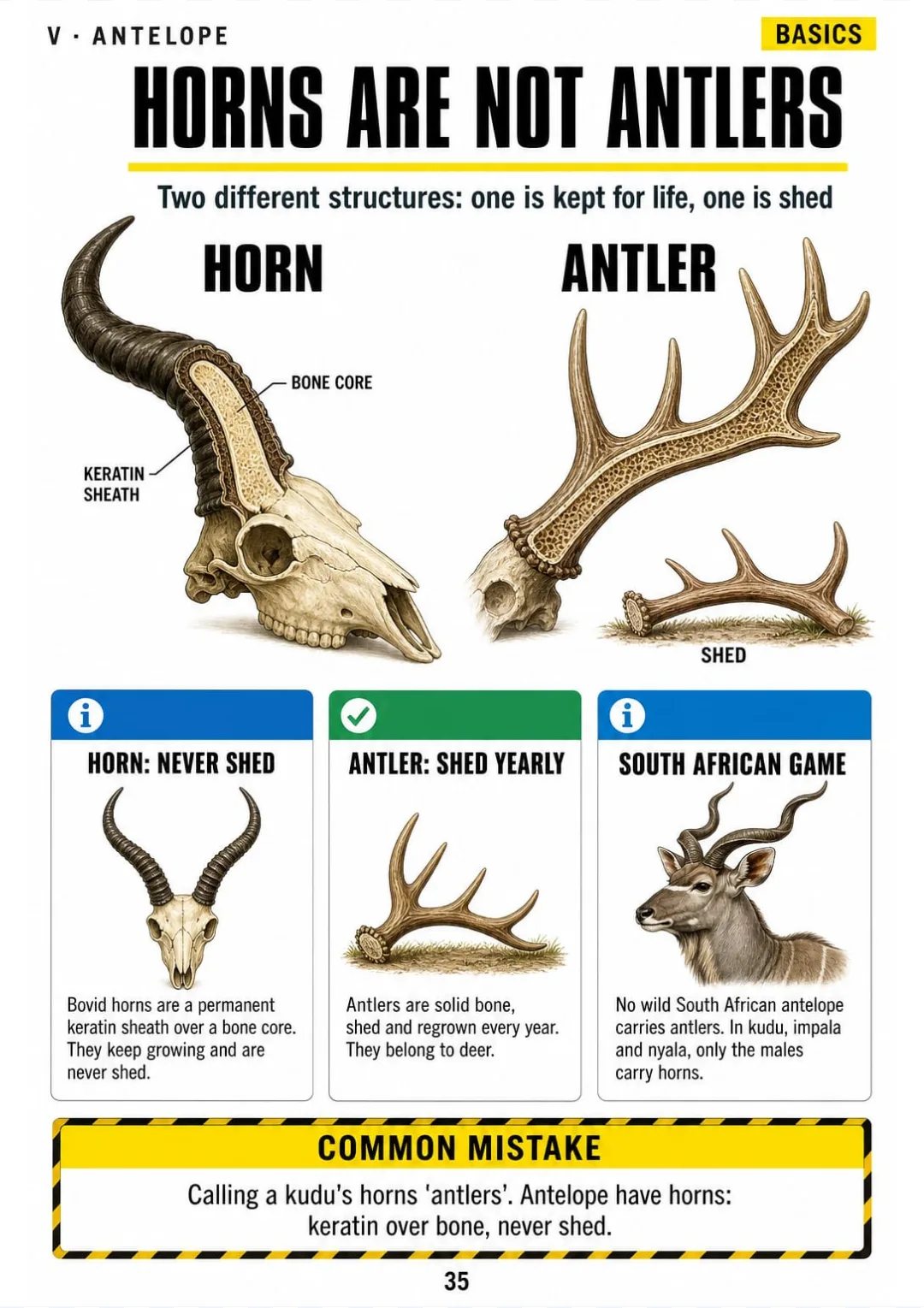
Horn = keratin sheath over a bone core, never shed. Antler = bone, shed every year.
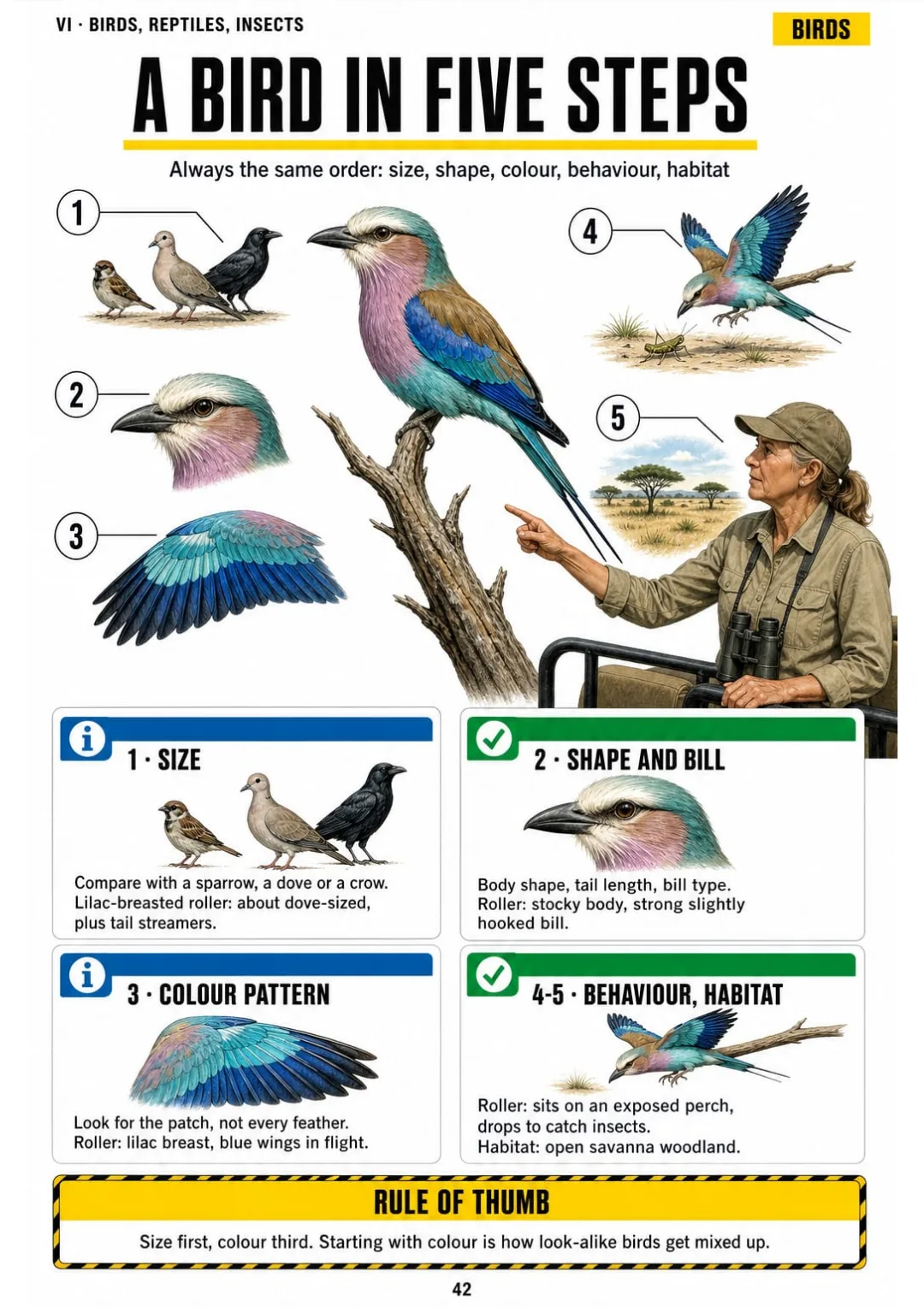
Size, shape, colour, behaviour, habitat: worked through on a lilac-breasted roller
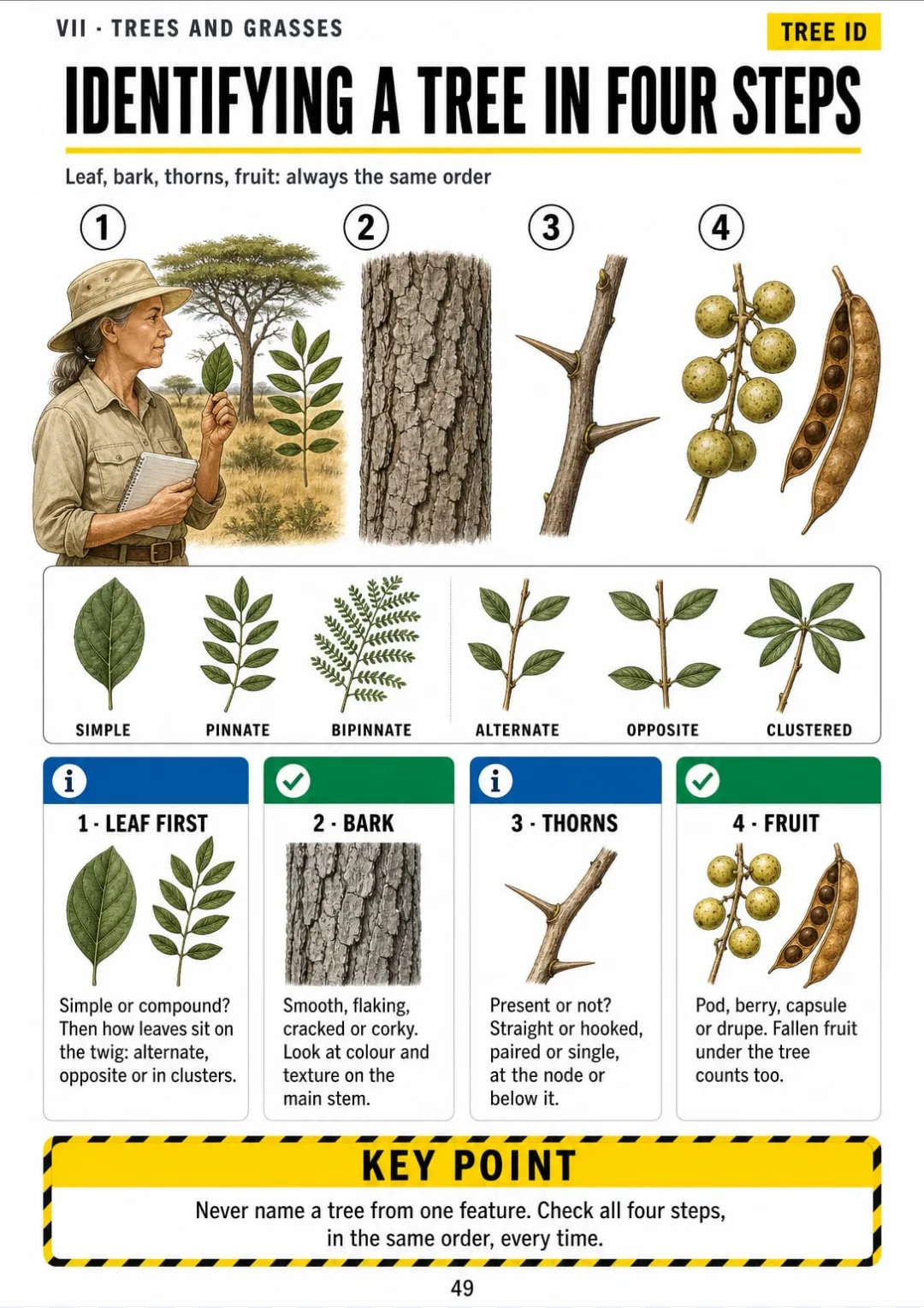
Tree ID in four steps, with simple, compound and bipinnate leaves drawn as a reference strip.
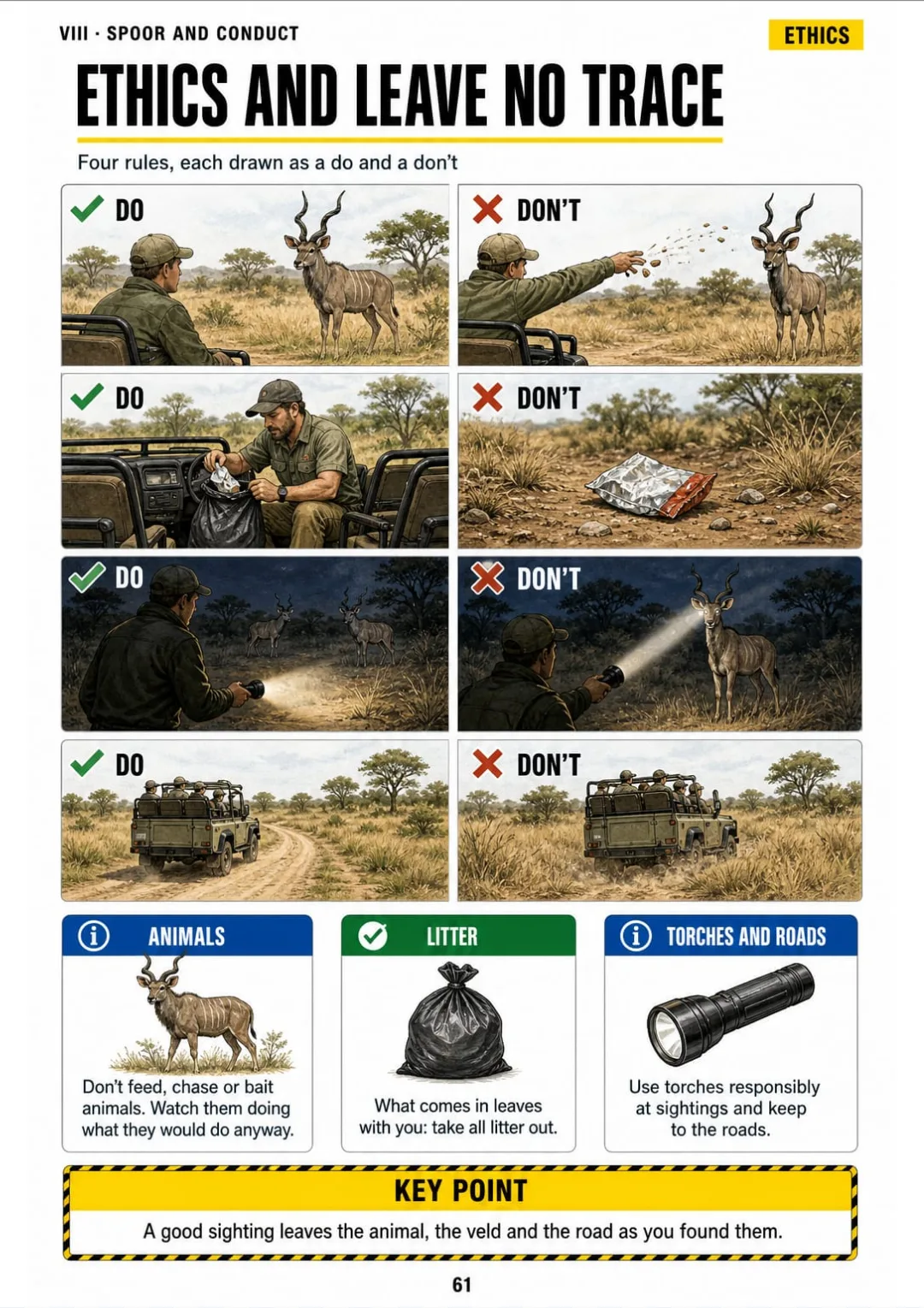
Four ethics rules, each shown as a drawn do and don't

Swipe to see more →

These are real pages from the book. The table of contents is the full one: 9 parts and 61 topics.

The Problem Isn't You. It's How It Was Explained to You.

You're on a granite koppie with guests and someone asks: "What kind of rock is this, and how did it get here?"

The manual covers it in three dense paragraphs: igneous, sedimentary, metamorphic and the rock cycle, all in words, with nothing to look at. On the spot, the three names blur into one.

Igneous, sedimentary, metamorphic: crystals, layers or reshaped by heat and pressure.

In this book it's one page: three drawings side by side. Crystals for igneous, layers for sedimentary, rock reshaped by heat and pressure for metamorphic, and arrows that close the cycle.

The same goes for taxonomy, horns and antlers, the five mammal orders, cat and dog spoor and tree identification: each one has its own page.

You see it, you understand it and you answer the guest without going back to the manual.

COMPARE FOR YOURSELF

The Same Topic, Two Ways to Study It

THIS
  • The manual: line after line
  • Taxonomy explained only in words
  • You reach the exam with doubts
Taxonomy is the science of classifying living organisms into hierarchical categories according to shared characteristics. The principal ranks, in descending order, are kingdom, phylum, class, order, family, genus and species. Under the binomial system of nomenclature established by Linnaeus, each species is assigned a two-part scientific name consisting of the genus followed by the specific epithet; the generic name is written with an initial capital letter, the specific epithet in lower case, and both are italicised, as in Aepyceros melampus, the impala.
FOR THIS
  • Taxonomy as a seven-rung ladder
  • The naming rules in one box
  • You see it and it makes sense
Kingdom to species in seven rungs: Aepyceros melampus, genus capitalised, both in italics.
CONTENTS

Take a Look at the 9 Parts and 61 Topics

The guide and the exam, ecology and biomes, earth and sky, big mammals, antelope, birds and reptiles, trees and grasses, spoor and safe conduct, and exam practice: 65 pages, all illustrated

IThe guide and the exam · pp. 5-8
  1. What a nature site guide actually does
  2. How the theory exam is laid out
  3. Interpretation: turning facts into a story
  4. The laws a guide works under
IIEcology and biomes · pp. 9-18
  1. Taxonomy: the seven-step ladder
  2. Food chains and the 10% rule
  3. Habitat, niche and carrying capacity
  4. Symbiosis in three drawings
  5. The nine biomes of South Africa on one map
  6. Savanna: grass with scattered trees
  7. Grassland: why there are no trees
  8. Fynbos: fire, winter rain and poor soils
  9. Nama Karoo versus Succulent Karoo
  10. Forest, thicket, coastal belt and desert
IIIEarth and sky · pp. 19-23
  1. Three rock types and the rock cycle
  2. Reading the landscape: koppies and dolerite
  3. Soils and what grows on them
  4. Weather: summer and winter rainfall
  5. Finding south with the Southern Cross
IVBig mammals · pp. 24-34
  1. How mammals are grouped
  2. African elephant
  3. White rhino versus black rhino
  4. African buffalo
  5. Hippopotamus
  6. Giraffe
  7. Plains zebra versus Cape mountain zebra
  8. Lion: the only social cat
  9. Leopard versus cheetah
  10. Spotted hyena and African wild dog
  11. Chacma baboon and vervet monkey
VAntelope and herbivores · pp. 35-41
  1. Horns are not antlers
  2. The four-chambered stomach
  3. Grazer, browser or mixed feeder
  4. Impala
  5. Nyala, bushbuck and kudu side by side
  6. Small antelope: steenbok, duiker and klipspringer
  7. Waterbuck, blue wildebeest and tsessebe
VIBirds, reptiles and insects · pp. 42-48
  1. Identifying a bird in five steps
  2. Raptors: eagles, vultures and the bateleur
  3. Breeding behaviour worth a story
  4. Venomous snakes by venom type
  5. Snakebite: first aid only
  6. Crocodiles and monitor lizards
  7. Insects and arachnids
VIITrees and grasses · pp. 49-53
  1. Identifying a tree: leaf, bark, thorns, fruit
  2. Vachellia versus Senegalia
  3. Five savanna trees to know
  4. Grass anatomy
  5. Increaser and decreaser grasses
VIIISpoor, dung and safe conduct · pp. 54-61
  1. Cat spoor versus dog spoor
  2. Hooves and big feet
  3. Reading dung
  4. Approaching game in a vehicle
  5. Elephant warning signs
  6. Guest briefing before every activity
  7. On foot: single file and never run
  8. Ethics and Leave No Trace
IXRevision and exam practice · pp. 62-65
  1. The identification method on one page
  2. Ten look-alike pairs to revise
  3. Most common mix-ups, before and after
  4. Theory exam checklist

One Page, One Topic, All Clear

Think of it this way:

It's the night before the theory exam and nyala, bushbuck and kudu still look like one animal in your notes.

You open their page and the three stand side by side, each with the feature that tells it apart marked on the drawing.

Horn = keratin sheath over a bone core, never shed. Antler = bone, shed every year.

The same with the nine biomes on one map, horns and antlers, cat and dog spoor, a bird in five steps and a tree in four: each one on its own page.

Field Guide Theory Illustrated is 9 parts and 61 topics, all drawn, and it ends with ten look-alike pairs, the most common mix-ups and a theory exam checklist.

What you see drawn, you don't have to memorize.

What's Inside Field Guide Theory Illustrated:

Ipp. 5-8

The guide and the exam

What a nature site guide does, how the theory exam is laid out, interpretation and the laws a guide works under

IIpp. 9-18

Ecology and biomes

Taxonomy, food chains and the 10% rule, habitat and niche, symbiosis and the nine biomes of South Africa, from savanna to desert

IIIpp. 19-23

Earth and sky

The three rock types and the rock cycle, koppies and dolerite, soils, summer and winter rainfall and finding south by the stars

IVpp. 24-34

Big mammals

How mammals are grouped, elephant, both rhinos, buffalo, hippo, giraffe, zebras, the big cats, hyena, wild dog and primates

Vpp. 35-41

Antelope and herbivores

Horns versus antlers, the four-chambered stomach, grazers and browsers, impala and the look-alike antelope side by side

VIpp. 42-48

Birds, reptiles and insects

A bird in five steps, raptors, breeding behaviour, venomous snakes by venom type, snakebite first aid basics, crocodiles and insects

VIIpp. 49-53

Trees and grasses

A tree in four steps, Vachellia versus Senegalia, five savanna trees, grass anatomy and increaser and decreaser grasses

VIIIpp. 54-61

Spoor, dung and safe conduct

Cat and dog spoor, hooves, reading dung, approaching game in a vehicle, elephant warning signs, guest briefings, walking safely and ethics

IXpp. 62-65

Revision and exam practice

The identification method on one page, ten look-alike pairs, the most common mix-ups before and after and a theory exam checklist

At the end of the book: Ten look-alike pairs, the most common mix-ups before and after, and a theory exam checklist.
Plus: 2 Free Books

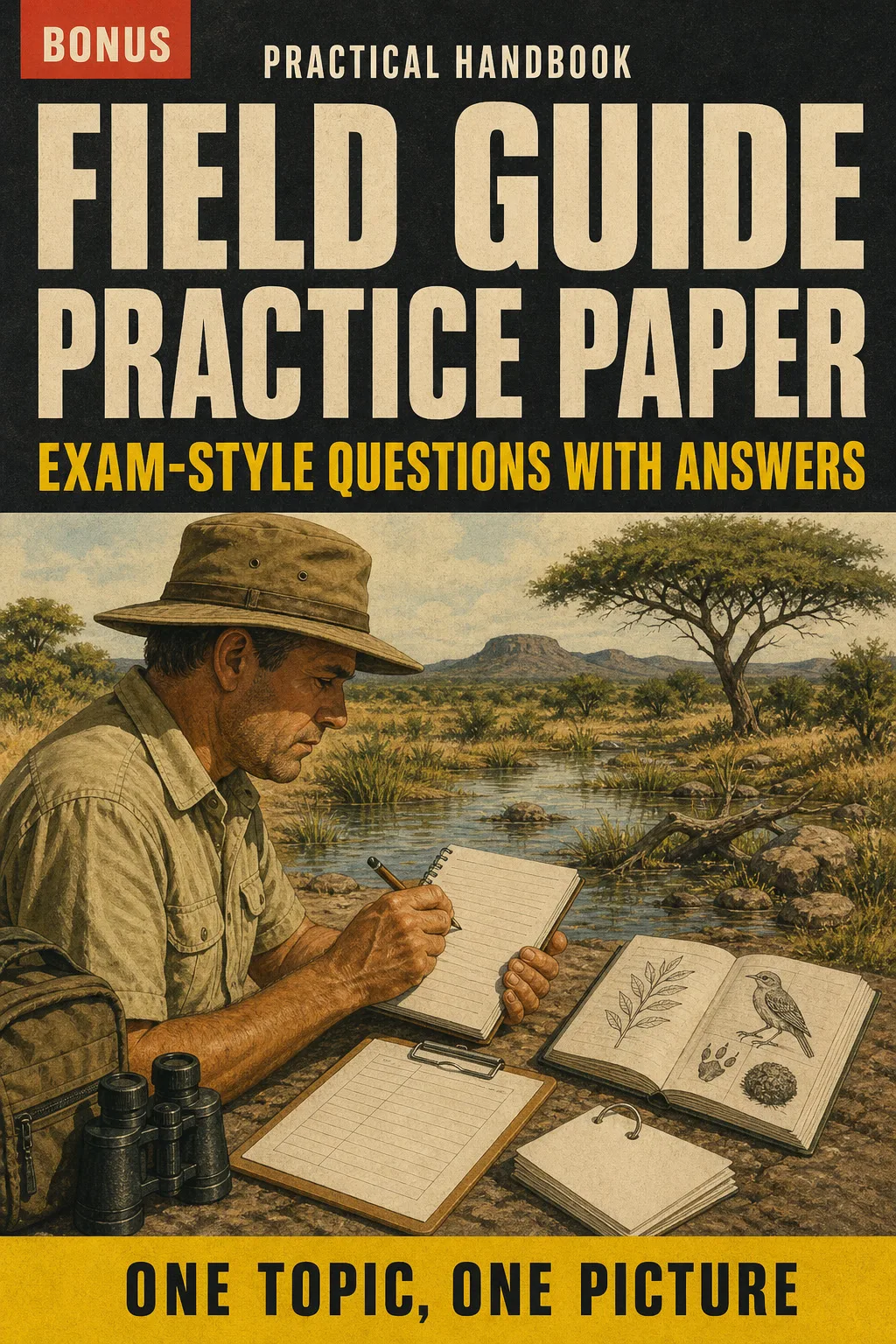
Field Guide Practice Paper: Exam-Style Questions with Answers

BONUS 1: «Field Guide Practice Paper: Exam-Style Questions with Answers»

Value on its own: US$ 17.90

Test yourself topic by topic before the theory exam and see exactly why each answer is right.

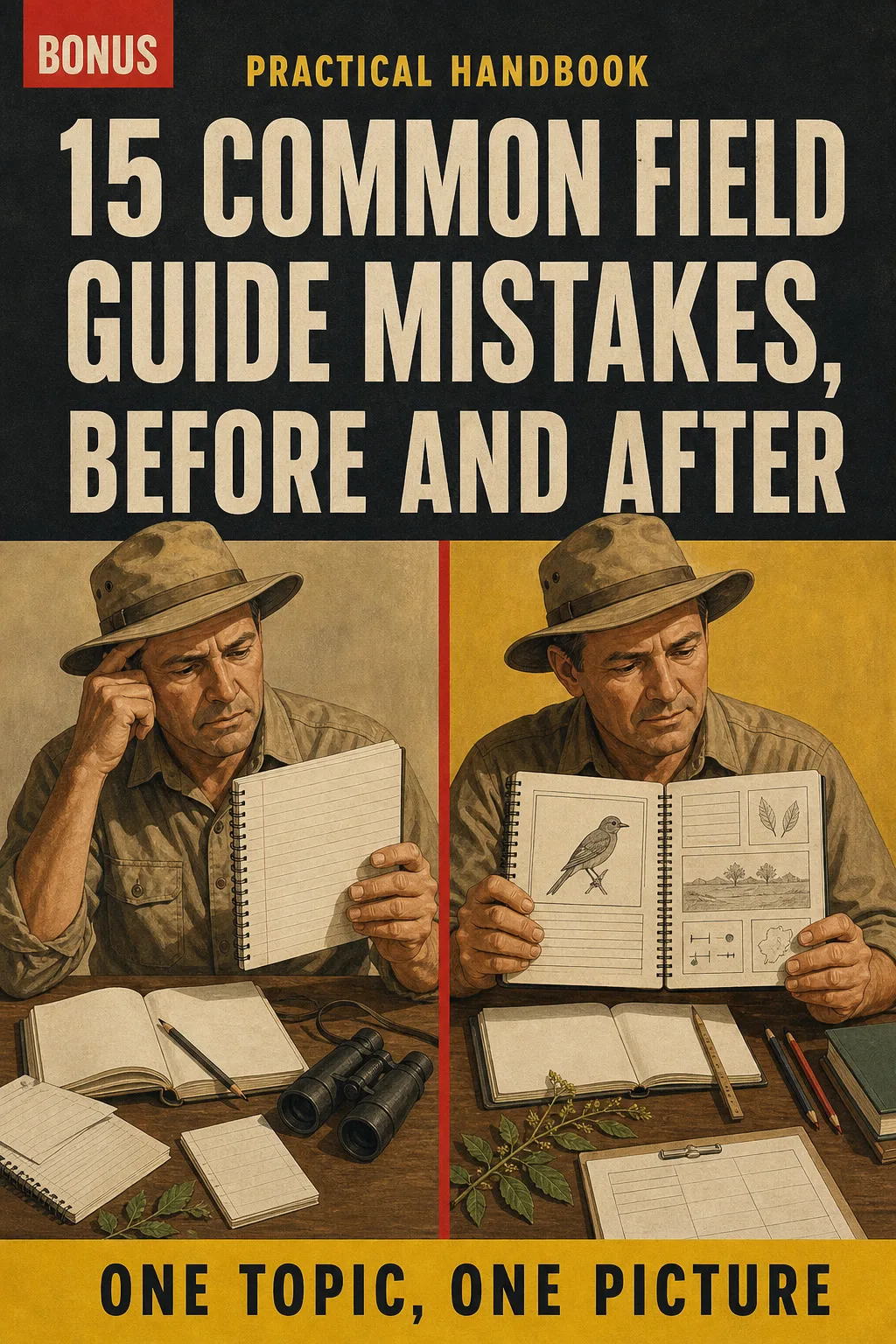
15 Common Field Guide Mistakes, Before and After

BONUS 2: «15 Common Field Guide Mistakes, Before and After»

Value on its own: US$ 14.90

See the mix-ups that trip up new guides, from look-alike antelope to vehicle positioning, each one drawn wrong and then right.

Field Guide Theory Illustrated with 2 Free Books

  • Field Guide Theory Illustrated: 65 illustrated pagesUS$ 63
  • BONUS 1: Field Guide Practice Paper: Exam-Style Questions with AnswersUS$ 17.90
  • BONUS 2: 15 Common Field Guide Mistakes, Before and AfterUS$ 14.90
  • High-resolution PDF to printIncluded
Total value US$ 95.80
YOUR PRICE:
US$ 27
You save US$ 68.80
YES, I WANT FIELD GUIDE THEORY ILLUSTRATED FOR US$ 27

📄 This is a digital PDF book sent to your email: nothing is printed or shipped.

Secure purchaseEncrypted payment30-day guarantee

PDF by email: We email you Field Guide Theory Illustrated as a PDF, together with the two free books. It's a single payment: no installments, no extra charges.

Who This Book Is For

You're on a field guide course

You're on a field guide course

Every topic in the manual has its own drawn page, so you revise in the same order every evening and the names start to connect.

Your theory exam is close

Your theory exam is close

Look-alike pairs, the most common mix-ups and the practice paper let you check topic by topic what you know and what still needs work.

You already work at a lodge

You already work at a lodge

You know the animals; the book adds the theory around them: biomes, rocks, soils, taxonomy and food webs, one page each.

Everything You Get Today

US$ 95.80US$ 27
YES, I WANT FIELD GUIDE THEORY ILLUSTRATED FOR US$ 27

📄 This is a digital PDF book sent to your email: nothing is printed or shipped.

30DAYS
GUARANTEE

30-Day Guarantee

Try Field Guide Theory Illustrated for 30 days, bonus books included.

We refund everything if the file won't open, if the book isn't what you see here, if you were charged twice or if the email doesn't arrive. Just email us.

You pay once. No subscriptions.

Frequently Asked Questions

Is it for me if I'm changing careers and starting from zero?

Yes. Each topic starts from the drawing and builds up step by step. If you already have years in the bush, it gives you the theory side in the same order as the syllabus.

Where does the content come from?

It's written for South Africa: South African species, the nine SANBI biomes and the laws a guide works under here. It is checked against the NQF Level 2 Nature Site Guide unit standards registered with SAQA, the published FGASA theory syllabus, the Tourism Act 3 of 2014 and the SANBI biome classification. The text and drawings are our own.

Is it official material?

No. It is independent study material and is not affiliated with or endorsed by any association, authority or training provider.

Does it replace the course?

No. It sits next to your course manual: the same topics, but each one on a drawn page with the features that tell look-alikes apart, so you revise faster and in the same order. It doesn't give a certificate. The accredited course, field training, the practical assessment and a first aid course are still needed.

Are the practice questions the ones from the exam?

No. They are written for this book, in exam style, to help you test yourself topic by topic.

How does it arrive?

As a PDF by email, sent to the address you enter at checkout: the book and the 2 bonuses.

Is it for the South African NQF2 theory exam?

Yes. It follows the NQF Level 2 Nature Site Guide theory, with South African biomes, trees, animals and the Tourism Act. It's a revision aid, not a guarantee of passing.

Can I have it on paper?

Yes. The PDF is A4-friendly, so you can print the whole book or just the pages you want to take to the course.

How does the refund work?

You have 30 days. We refund everything if the file won't open, if the book isn't what you see on this page, if you were charged twice or if the email doesn't arrive: just email us.

Before You Close This Page

No more rereading without anything sticking.

Rock types, spoor and look-alike antelope: you see them drawn and that's it.

You reach the exam knowing where everything is.

Drawings make studying faster.

The book is right below.

One-time payment: US$ 27 · Guarantee: 30 days · PDF by email

YES, I WANT FIELD GUIDE THEORY ILLUSTRATED FOR US$ 27

📄 This is a digital PDF book sent to your email: nothing is printed or shipped.